

Grundkenntnisse der deutschen Sprache gehören zu den Voraussetzungen, um in Österreich leben und arbeiten zu können. Die deutsche Sprache erleichtert Ihnen den Umgang mit Arbeitgeber*innen, Behörden und medizinischem Personal und hilft Ihnen, Ihre Kinder auf ihrem Bildungsweg in Österreich zu unterstützen.
Wir helfen Ihnen bei der Suche nach dem passenden Deutschkurs und bei der Finanzierung der Kurskosten.
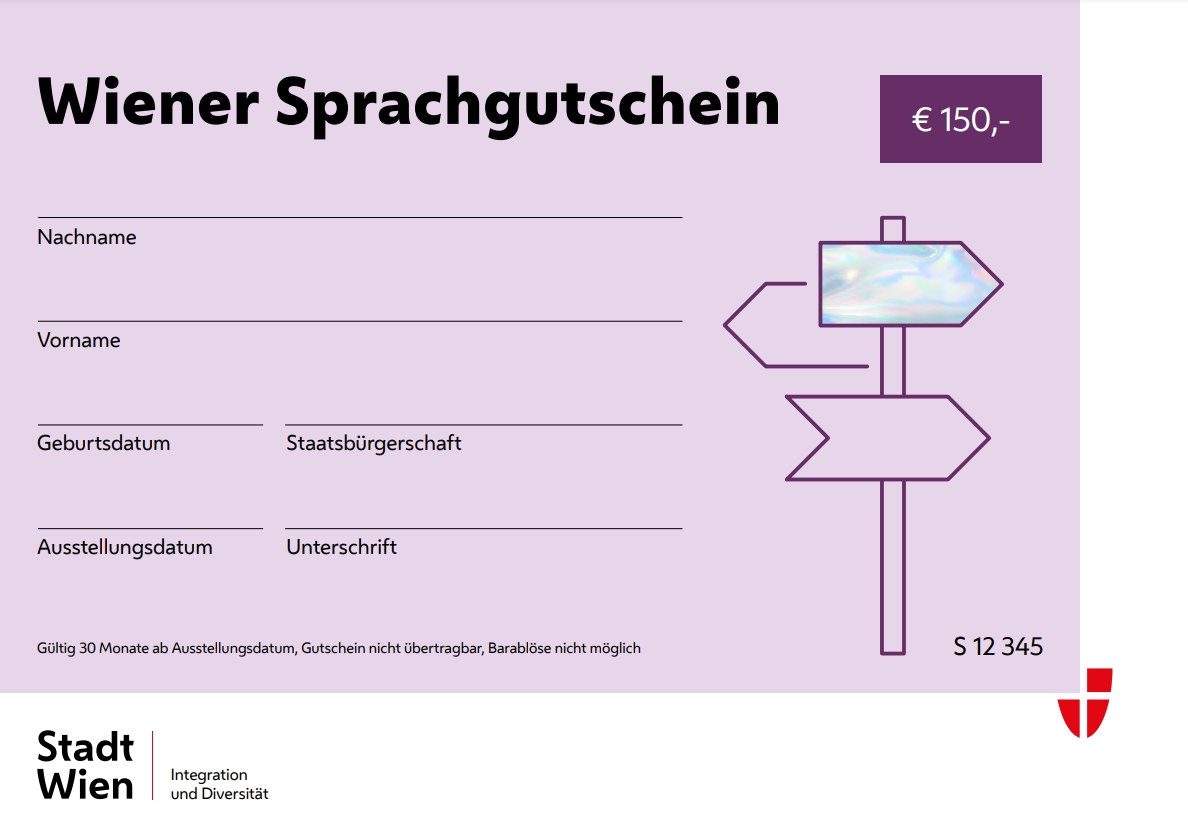
Vereinbaren Sie ein Startcoaching in Ihrer Sprache und erhalten Sie Ihren Wiener Sprachgutschein in der Höhe von 150 Euro.
Wir helfen Ihnen bei der Suche nach dem passenden Deutschkurs und bei der Finanzierung der Kurskosten.
Vereinbaren Sie ein Startcoaching in Ihrer Sprache und erhalten Sie Ihren Wiener Sprachgutschein in der Höhe von 150 Euro.
Startcoaching für neu zugewanderte Menschen – Beratung für Ihren guten Start in Wien
- Vereinbaren Sie einen Startcoaching Termin, wenn Sie Ihren Erstaufenthaltstitel von der Behörde (MA 35) erhalten und Ihren Hauptwohnsitz in Wien haben. ACHTUG: Menschen, die sich nur vorübergehend in Wien aufhalten, haben keinen Anspruch auf Startcoaching.
- Stellen Sie Ihre Fragen bei einem kostenlosen Gesprächstermin in Ihrer Erstsprache
- Informationen über Wohnungssuche, Arbeitsverträge, Schulwahl, Integrationsvereinbarung und vieles mehr
- Persönliche Unterstützung bei der Suche nach einem passenden Deutschkurs
Wiener Sprachgutschein
Wer bekommt den Wiener Sprachgutschein?
Der Wiener Sprachgutschein ist eine einmalige Unterstützung für folgende Menschen, die in den letzten 2 Jahren neu nach Wien zugewandert sind: - Menschen aus einem Drittstaat (Drittstaatsangehörige) mit einem der folgenden Erstaufenthaltstitel:
o Rot-Weiß-Rot Karte plus
o Rot-Weiß-Rot Karte
o Niederlassungsbewilligungen
o Familienangehöriger
o Blaue Karte EU
o Artikel 50 EUV (Brexit)
o Aufenthaltskarte für Angehörige aus Drittstaaten von Personen mit EWR- oder Schweizer Staatsangehörigkeit - Menschen mit der Staatsbürgerschaft eines EU-Landes, von Island, Liechtenstein, Norwegen oder der Schweiz mit Anmeldebescheinigung
Wo erhalten Sie den Wiener Sprachgutschein?
Bei Ihrem kostenlosen Startcoaching-Termin. Die Stadt Wien bietet neu zugewanderten Menschen individuelle kostenlose Beratungsgespräche in mehr als 20 verschiedenen Sprachen an. Wo und wofür können Sie den Wiener Sprachgutschein einlösen?
- Bei allen Kursanbieter*innen, die von der Abteilung für Integration und Diversität der Stadt Wien zertifiziert wurden
- Für Kurse der Sprachstufen A1, A2 und B1 mit mindestens 80 Unterrichtseinheiten pro Kursstufe
- Der Gutschein muss auf der Rückseite von einem autorisierten Partner abgestempelt sein. Erst dann ist er gültig.
Den Stempel bekommen Sie nach dem Besuch eines Info-Moduls oder bei einem persönlichen Beratungstermin zu den Themen Anerkennung von Qualifikationen (AST) oder Unternehmensgründung (Wirtschaftsagentur Wien).
Hier finden Sie Deutschkurse von Kursanbieter*innen, die von der Stadt Wien zertifiziert wurden.
Bei diesen Kursanbieter*innen können Sie Ihren Wiener Sprachgutschein in der Höhe von 150 Euro einlösen.
Bei diesen Kursanbieter*innen können Sie Ihren Wiener Sprachgutschein in der Höhe von 150 Euro einlösen.
Weitere finanzielle Förderungen für Deutschkurse
- ÖIF-Bundesgutschein: Der Gutschein vom Österreichischen Integrationsfonds(ÖIF) wird von der Stadt Wien - Einwanderung und Staatsbürgerschaft (MA 35) bei der Abholung des Erstaufenthaltstitels ausgestellt. Den Gutschein erhalten Personen, die die Integrationsvereinbarung erfüllen müssen.
- AK-Bildungsgutschein: Den Bildungsgutschein der Arbeiterkammer (AK) können Sie einmal im Jahr für Weiterbildungen (z. B. Deutschkurse) in Anspruch nehmen. Voraussetzung ist eine Mitgliedschaft bei der AK. Den Bildungsgutschein können Sie telefonisch oder über ein Online-Formular bei der AK beantragen.
- waff-Förderungsfonds: Der Wiener Arbeitnehmer*innen-Förderungsfonds(waff) vergibt Förderungen für berufliche Aus- und Weiterbildung. Bei einem Beratungs-Termin können Sie sich über Förderungen für einen Deutschkurs erkundigen.
Sie bieten Deutschkurse an und möchten mit uns zusammenarbeiten?